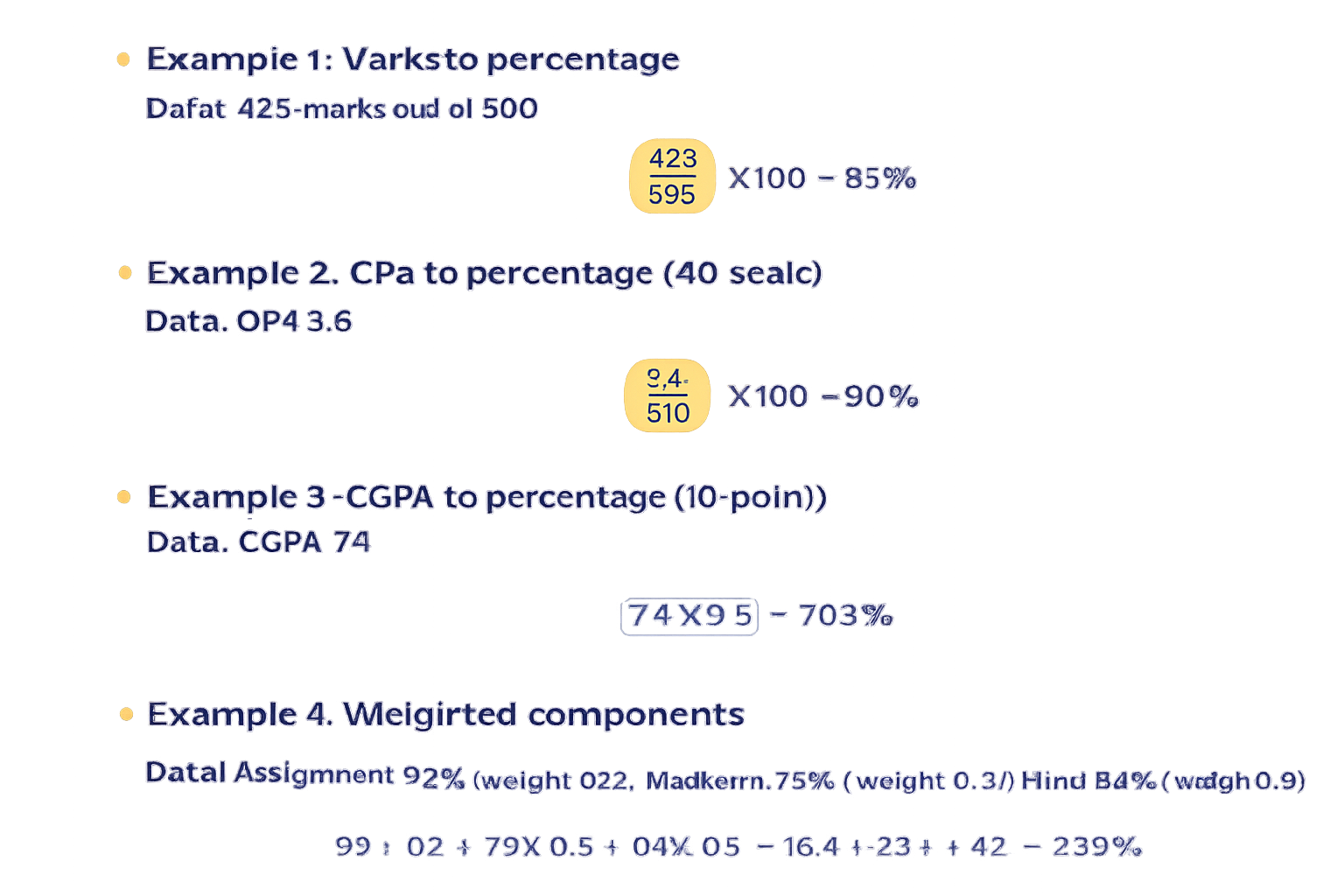
Grades to percentage calculator: A clear, beginner?friendly guide
Whether you’re a student double?checking your marks or a parent trying to make sense of grade reports, converting grades into percentages shouldn’t feel like decoding a secret. This guide cuts through the jargon, explains the formulas in plain English, and gives you a simple, reliable way to calculate percentages from grades. I’ll also cover different grading systems (letter grades, GPA, and marks out of totals) and common pitfalls so you can quickly find what you need.
What a grades to percentage calculator does
A “Grades to Percentage Calculator” takes your grade input (marks, GPA, or letter grade) and converts it into a percentage based on a defined scale. It’s useful when:
-
Comparing results: You want a consistent measure across subjects or institutions.
-
Applying for admissions or jobs: Many forms ask for percentages.
-
Tracking progress: Percentages offer precise milestones across a semester.
How to convert letter grades to percentage
Different schools use different cutoffs. Always verify your institution’s official scale. Here’s a common, widely used scale to get started:
| Letter grade | Typical percentage range | Grade points (4.0 scale) |
|---|---|---|
| A | 90–100% | 4.0 |
| A− | 87–89% | 3.7 |
| B+ | 83–86% | 3.3 |
| B | 80–82% | 3.0 |
| B− | 77–79% | 2.7 |
| C+ | 73–76% | 2.3 |
| C | 70–72% | 2.0 |
| C− | 67–69% | 1.7 |
| D | 60–66% | 1.0 |
| F | 0.0 |
Sources: Refer to your university or board’s handbook; ranges vary by country and institution.
Quick conversion tip
-
A grade: Usually 90% and above
-
B grade: Typically 80–89%
-
C grade: Usually 70–79%
-
D grade: Often 60–69%
-
F grade: Below 60%
How to convert GPA to percentage
GPA (Grade Point Average) converts to percentage using an institution’s official formula. Some use linear mappings; others use banded conversions.
Common linear conversion (4.0 scale)
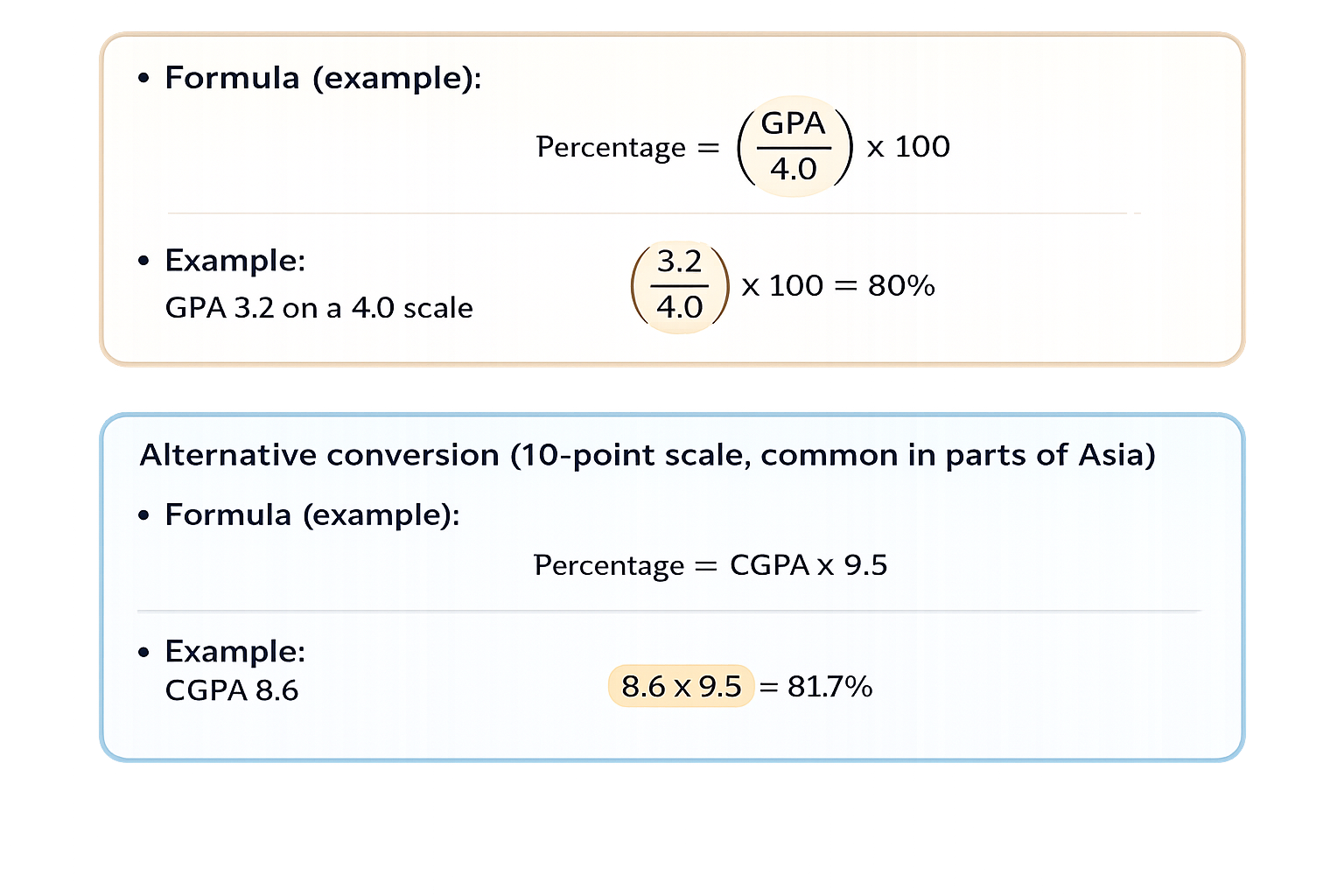
Tip: Your board or university may publish a specific conversion factor (e.g., 9.5 or 9.25). Always check official guidance before finalizing transcripts.
Step by step: Using a grades to percentage calculator
-
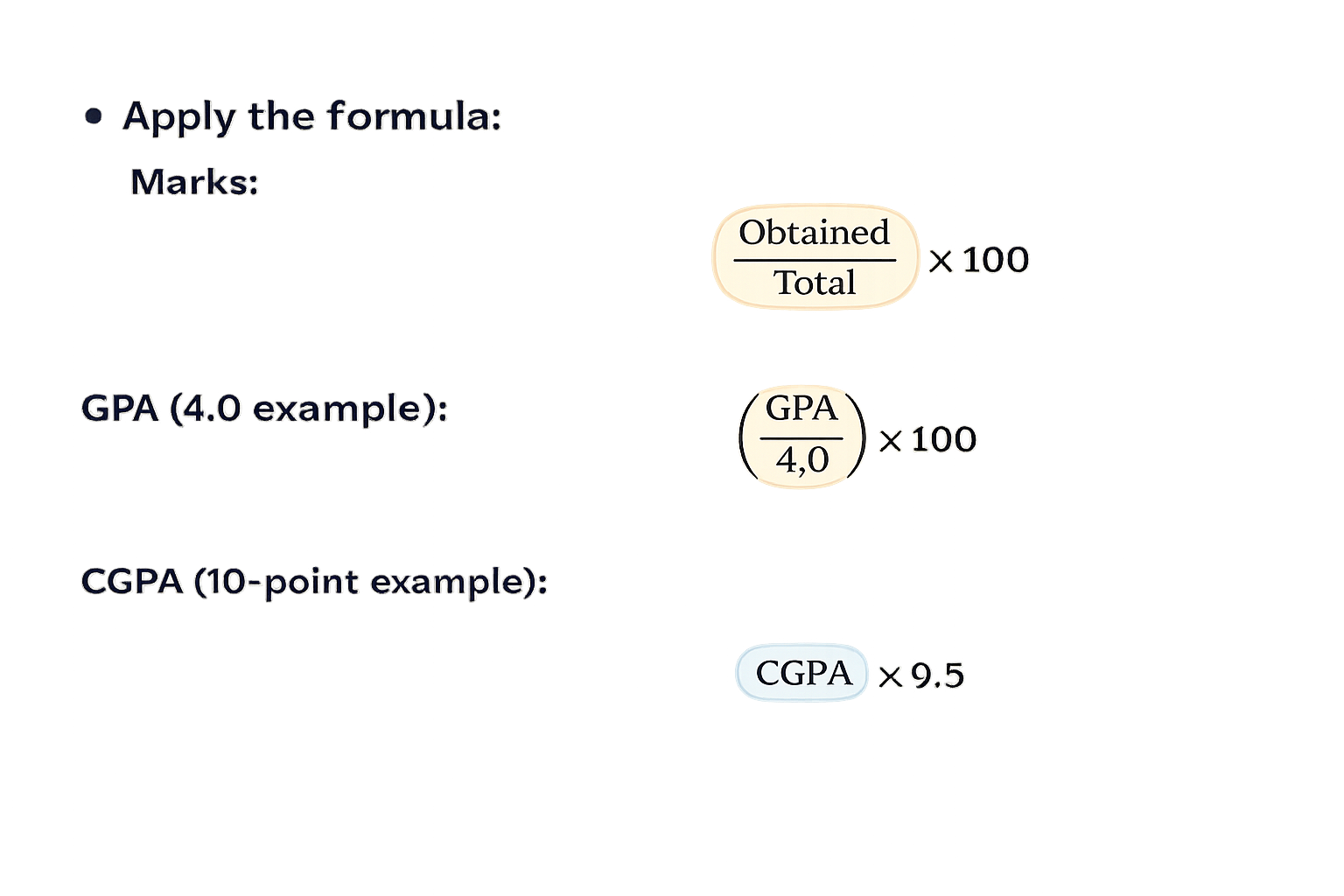
Identify your input: Type: marks out of total, letter grade, or GPA.
-
Find your scale: Policy: 4.0 GPA, 10?point CGPA, letter?to?percent mapping.
-
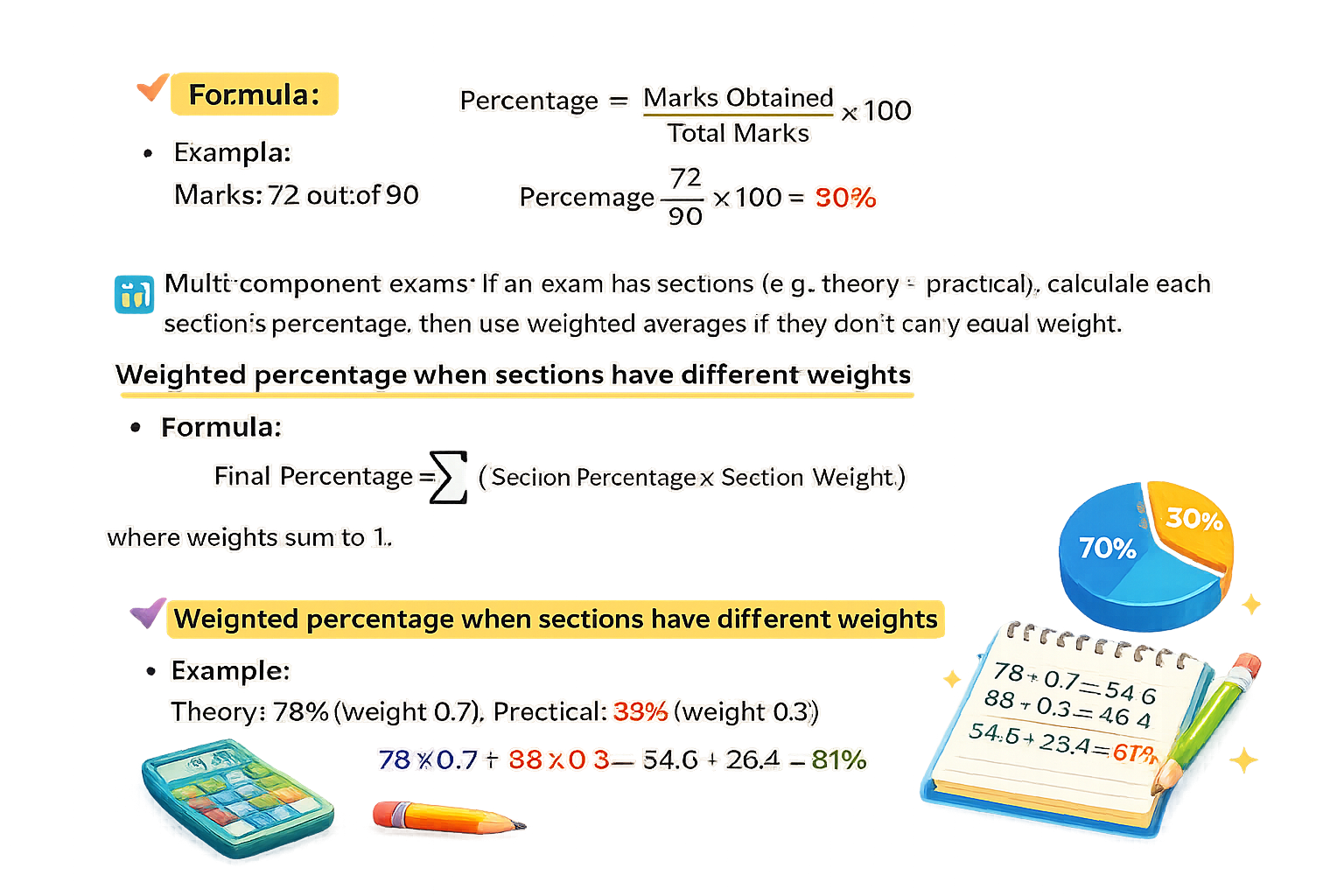
Adjust for weights: Weighted average: If components have different weights, use weighted percentages.
-
Round sensibly: Policy: Many institutions round to two decimals or nearest whole number. Match the official policy.
Common mistakes and how to avoid them
-
Using the wrong scale: Check: Don’t use a US 4.0 scale for a 10?point CGPA, or vice versa.
-
Ignoring weights: Result: A high practical score can distort your total if you forget its lower weight.
-
Inconsistent rounding: Fix: Use the same rounding rule across all courses; document it if required.
-
Mixing percentage and grade points: Rule: Convert everything into one system before averaging.
Real world examples